Futurist at National Outdoor Sports Congress: 'Change your organisation and use AI' |
|
|
|
|
 |
| 126 sec |
During the first National Outdoor Sports Congress of industry association BSNC, futurist and trendwatcher Richard van Hooijdonk took the audience on a dynamic journey into the near future. His central message: AI is not a hype, but a fundamental force that will radically change the way outdoor sports facilities are managed, maintained and designed.
| Vice-chair of BSNC Seth van der Wielen signs the Clean and Emission-Free Construction covenant. (Photos: Rob Gieling Fotografie) |
Van Hooijdonk outlined how generative AI, robots and sensor technology are taking over predictable and repetitive tasks. Examples include robotic mowers that maintain sports fields fully autonomously, sensors in turf that predict recovery or indicate when a match should be cancelled, and cameras that analyse field use and wear in real time. 'It is incredibly outdated that we still carry out most maintenance with people,' he emphasised. 'It can be done faster, smarter and more consistently.'
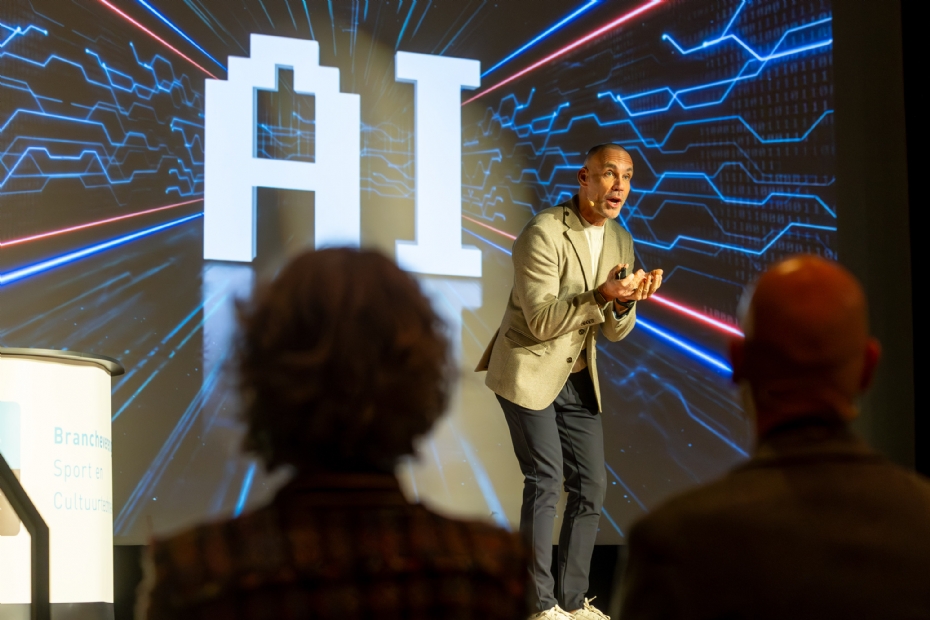 | | Richard van Hooijdonk shared his vision on AI. |
|
|
Ecosystems
According to him, the biggest shift is not technological but cultural and organisational. 'AI does not replace people. People who do not use AI will be replaced by people who do.' Organisations therefore need to switch to an AI-first approach: working smarter with digital assistants, automating processes and organising teams differently. Curiosity, collaboration and building so-called ecosystems are crucial in this process. Van Hooijdonk warned that many companies are not sufficiently prepared. 'We are at the intersection of robotisation, AI and extreme speed. But only 14 per cent of organisations have the skills to manage this transition.' His message was clear: invest in knowledge now, actively involve young professionals in decision-making and develop joint innovation capacity within the sector. 'The cost of doing nothing is higher than the cost of action. The sports fields of the future will not emerge by themselves; we have to build them today.'
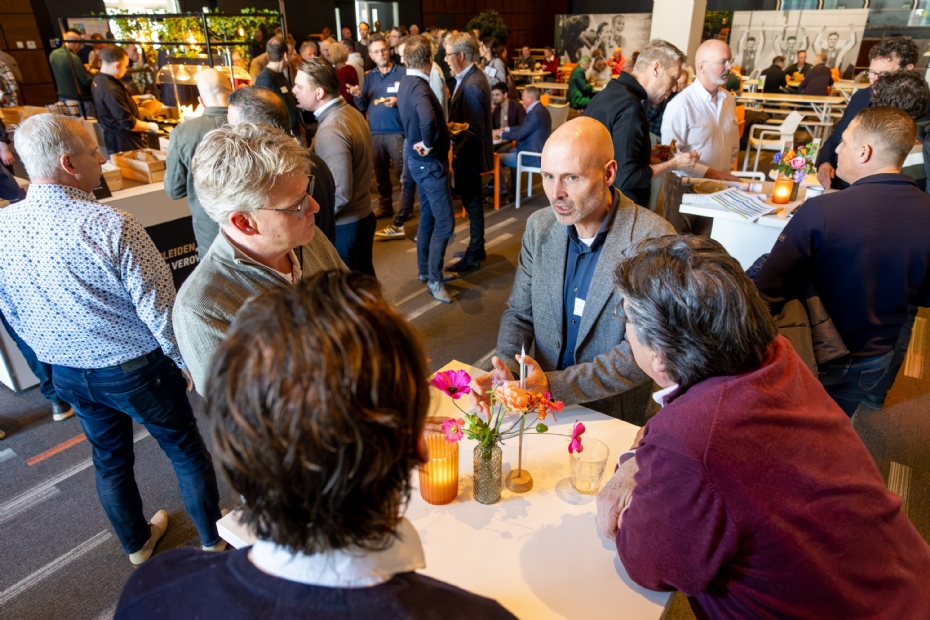 | | There were many breaks, providing ample opportunity to meet and network. |
|
|
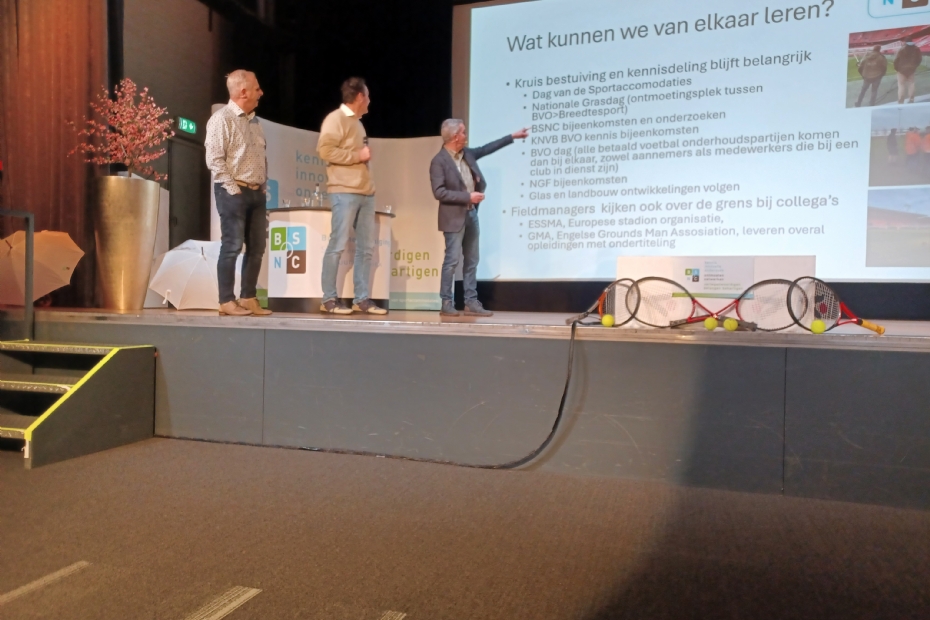 | | Mark Valstar, Paul Baas and Henk Slootweg. (Photo: NWST) |
|
|
Field maintenance
During one of the in-depth sessions on field maintenance, specialists Mark Valstar (municipality of Westland), Henk Slootweg (AH Vrij) and Paul Baas (De Enk) shared their experiences with the latest developments in turf management. The key message: stadium technology and data-driven maintenance are increasingly finding their way to amateur fields. Through the use of sensors, weather stations, drainage systems and electrification of machinery, a much more precise picture emerges of what a field requires. This allows clubs to irrigate more efficiently, respond better to climate and usage, and monitor maintenance remotely.
Slootweg and Baas emphasised that innovations often originate at professional football clubs, such as lighting units, new grass seed mixtures or hybrid constructions, but eventually filter through to municipalities and associations. Valstar underlined the value of this knowledge sharing, especially now that volunteer numbers are declining and budgets are under pressure. By working together and using data, a better understanding develops of field load, quality and maintenance cycles. High-quality natural grass standards are thus moving closer to grassroots sport.
Breakout sessions
Other breakout sessions addressed topics such as Product Category Rules (PCR) for artificial turf sports surface products and the introduction of a sustainability label, sustainable maintenance of artificial sports fields, the Scale Up project in Amsterdam and Haarlem, the impact of climate change on maintenance plans for (hybrid) grass sports fields, and the first steps towards sustainable hybrid grass fields with degradable artificial fibres. On this last topic, Jacco Meijerhof of Hofmeijer and René van Bremen of Senbis provided further explanation. A trial with this specific fibre will start this month on a referees' strip at a small football club.
Several formal matters were also addressed during the congress. The Clean and Emission-Free Construction covenant was signed, aimed at reducing emissions of nitrogen, CO2 and particulate matter. The Model Guarantee Statement for artificial turf football fields was presented, and the Annual Maintenance Calendar for grass sports fields was officially handed over.
This article was previously published on 5 February 2026 on the Fieldmanager](https://www.fieldmanager.nl/article/52880/futurist-op-nationaal-buitensport-congres-verander-jouw-organisatie-en-gebruik-ai]Fieldmanager) website.
| AH Vrij Groen, Grond en I... | |
| Hofmeijer Civiel en Cultu... | |
| Senbis Sustainable Produc... | |
| |
| LOG IN
with your email address to respond.
|
|
|
| There are no comments yet. |
|
| |
Anyone can place small ads for free through their own account.
Place a free ad
|
|
|
|








