Planthunter Raf Lenaerts receives international recognition with his Cercis 'Blue Lagoon' |
|
|
|
|
 |
| 187 sec |
'I once got the UK foreign secretary under Thatcher on the phone because he heard I had certain plants'
During IPM Essen, Plantipp received no fewer than four awards for new introductions. One of these was the Cercis griffithii 'Blue Lagoon' by Belgian Raf Lenaerts. Lenaerts talks about his long journeys to Taiwan and Vietnam in search of new species, and how he discovered the striking blue-grey colour of the awarded Cercis at his own nursery.
Lenaerts runs his own nursery, Botanic Treasures, where he focuses on unusual and rare trees and shrubs. These are species that are not part of the standard assortment and often mainly appeal to plant enthusiasts. 'I deliberately look for plants that are hard to find,' Lenaerts explains. That starting point has guided his work for many years. His specialisation includes magnolias, with a strong interest in evergreen species and new introductions from Asia. In addition, the range consists of a wide variety of woody plants that Lenaerts selects, propagates and offers himself, usually in relatively small numbers.
Botanical journeys as a source of inspiration
A large part of Lenaerts' plant knowledge comes from botanical journeys. He has visited, among other places, Taiwan and Vietnam, where he searches for shrubs and trees that may be winter-hardy in Belgium, the Netherlands and other parts of Europe. 'You come across an enormous amount there,' he says. At the same time, he draws clear boundaries. Not everything that is botanically interesting is also suitable for the European climate.
For the future, new regions are on his wish list, such as the border area between Vietnam and Laos. He also mentions Myanmar and China as areas where much remains to be discovered, although these are currently difficult to access.
From seedling to selection
The award-winning Cercis griffithii 'Blue Lagoon' was not deliberately bred, but the result of careful observation. Lenaerts sowed the species and noticed at an early stage that one seedling clearly differed from the rest. 'This species is greyish anyway, but this one was really distinctly blue-grey,' he recalls. 'That was a big difference compared to all the other seedlings, so I kept it separate and continued to grow it on.'
He recognises such deviations quickly. Lenaerts sows a lot and selects plants that stand out visually. Not every selection leads to a commercially interesting cultivar. Sometimes it remains a plant for enthusiasts that is offered in small numbers. In the case of 'Blue Lagoon', the potential proved greater, although it took several years before the plant was ready for introduction.
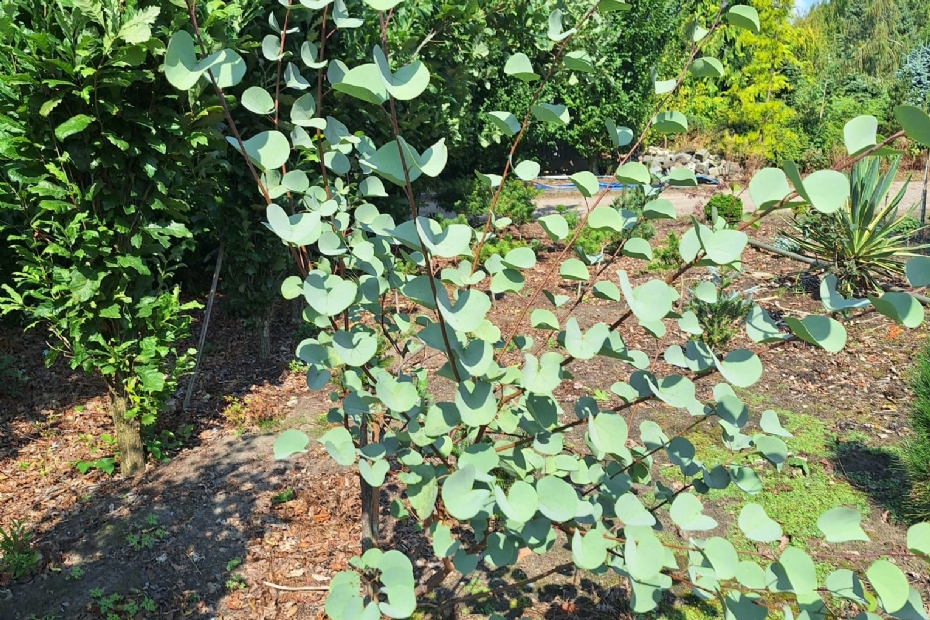 | | The Cercis Blue Lagoon |
|
|
Difficult propagation
An important reason for the long lead time was propagation. Grafting proved difficult and scaling up was not easy. Initially, the cultivar therefore remained in the background. Only when the plant could be propagated via tissue culture did the process gain momentum. From that moment on, the parties involved resumed the process and the cultivar could be prepared for market introduction. By then, Lenaerts had owned the plant for six to seven years. 'Blue Lagoon' is now ready for the market and the first plant material is becoming available.
Network of enthusiasts and collections
In addition to long-distance travel, Lenaerts' international network also plays an important role in his work. He maintains close contacts with botanical gardens and private collections, particularly in England. Each year, he visits major gardens in places such as Cornwall, where plants are propagated, grafted and exchanged. This network is based on mutual trust and a shared interest in unusual plants. What strikes Lenaerts is how status seems to disappear in that world. According to him, it is all about the plant itself, not the background of the collector or grower. 'I have good contacts in England, for example with Caerhays Castle,' he says. 'But when you work with plants at that level, it doesn't matter who you are.'
|
|
'Someone even flew in from Latvia with cardboard and everything so the plants could be packed and taken onto the plane'
| |
|
From enthusiasts in Spain to the Czech Republic and Sweden
Each year, the Belgian planthunter organises an open day at his nursery, where he presents all his new introductions, some of which he has only five or six plants of. Visitors come from all over Europe. 'The gate opens at ten o'clock and within the first fifteen minutes all the rarities are gone,' Lenaerts says. 'There was someone who came especially by plane from Latvia, bringing cardboard and everything, to pack the plants and take them back on the plane.'
The nursery's reputation has grown strongly in recent years, partly through word of mouth and social media. Since the coronavirus period, interest in unusual plants has increased noticeably, Lenaerts observes.
Commerce as support
Although the IPM award brings extra attention, Lenaerts remains pragmatic about the commercial side. Successful introductions mainly give him more financial room. 'That gives me a bit more freedom to do what I want,' he says. He uses that freedom to continue searching for new and unusual plants, even if they are only interesting for a limited audience.
At present, Lenaerts still combines his nursery with other work, but he expects to free up more time for Botanic Treasures in the near future. The nursery itself will remain small-scale. For him, growth is not about numbers, but about diversity and knowledge.
Confirmation of a working method
The IPM novelty award for Cercis griffithii 'Blue Lagoon' is mainly a confirmation of Lenaerts' way of working. Years of observing, selecting and waiting can eventually lead to an introduction with broad interest. For him, this changes little about the core of his work. 'My own nursery will always remain,' he says. The search for the unusual remains central.
This article was previously published on 4 February 2026 on the Boom
In Business website.
| LOG IN
with your email address to respond.
|
|
|
| There are no comments yet. |
|
| |
Anyone can place small ads for free through their own account.
Place a free ad
|
|
|
|








