Twelve control methods for Japanese knotweed |
|
|
|
|
 |
| 364 sec |
Smart combinations and persistence: one small root fragment is enough to start again
Japanese knotweed (Fallopia japonica) is a plant that gives land managers and contractors persistent headaches. The invasive species spreads rapidly, damages infrastructure and displaces native species. Several methods now exist to combat the plant, but not all are equally effective or practical.
| Fallopia japonica, Japanese knotweed |
Persistence and smart combinations often matter more than relying on a single method. This article provides land managers with a realistic overview of what works and what does not.
Excavation and sieving or removal: fast results, high cost
Excavation and removal involve digging out large root systems and contaminated soil down to about 3.5 metres and disposing of it as contaminated material. This method delivered the highest level of control in trials. It is a direct intervention, but an expensive one. Transporting contaminated material requires strict logistics to prevent further spread. For sites that require a quick result and are limited in size, this method is often chosen — but it comes with a substantial price tag.
André Evers of technical innovation firm Tibach: "Thermal treatment by incineration is often used to clean excavated soil. You effectively take soil out of circulation: around 40 percent is lost due to burning biomass in the soil." In sandy soils, if no cables or pipes are present, the excavated material can be sieved. Clean sand can then be returned.
 | | Andre Evers of Tibach |
|
|
Deep burial: cheaper, but less certain
In this approach, root-infested material is not removed but buried deep under clean soil. Costs are lower and the process is less invasive, but there is always a risk that the plant will reappear over time. The method requires precise execution and thorough follow-up monitoring.
Evers: "It takes a long time to know whether the solution is effective. Ideally, contaminated material should be deposited below groundwater level. After at least one year underwater, the rhizomes are no longer viable."
Anaerobic treatment: no oxygen, no plant
Anaerobic treatment (in depot or in situ), also known as roots reset, is a relatively new technique. The plant is mown first, then a nutrient solution is added and the site is sealed airtight. Without oxygen, the rhizomes die off through fermentation. In well-sealed locations, this proved effective in trials without chemical inputs. It is a method that requires precision and long-term monitoring.
 | | Gerrit van Nieuwenhuizen - RAMM |
|
|
Electrocution: targeted action
Electric treatment attacks Japanese knotweed from the inside: electricity flows through the stem into the roots — exactly where it is needed. "It is the only method that truly works inside the plant," says Gerrit van Nieuwenhuizen of RAMM. "Because the tough stems hardly allow other agents through, I advise removing the largest root blocks — the plant's 'power stations' — first, and then tackling the smaller remnants with the Electro Lance or RootWave Pro."
After four rounds per year, every six weeks, the population is almost gone — around 98 percent disappears. After each treatment, thinner stems return, which are easily burned away. The method is labour-intensive but effective: after three years, monitoring is sufficient. Everything you hit dies; what you miss survives. Treated stems should be removed, and barriers along plot boundaries are worth considering, since spread mainly occurs through stem and root fragments.
 | | Carlos Verschueren with CityZas |
|
|
More machines are used for electrical control of Japanese knotweed. One example is the CityZAS by Group Verschueren. Carlos Verschueren: "For larger infestations, we use a version attached to a hydraulic mowing arm, which destroys the plant down to the roots with 8,000 volts and 36 kW. The CityZAS uses half that power, so repeated treatments are needed, but it is suitable for paved urban areas and hard-to-reach sites."
Volume electrocution is a new technique in the Netherlands. A unit mounted on a robotic arm delivers multiple 8,000-volt pulses to the plant via trailing contacts. This method achieves strong reduction of Japanese knotweed at relatively low cost, provided there are enough infestation hotspots nearby. Between 2,500 and 3,500 m² can be treated per day.
 | | The hydraulic mowing arm delivering 8,000 volts and 36 kW to destroy the plant to the root (image via Tibach) |
|
|
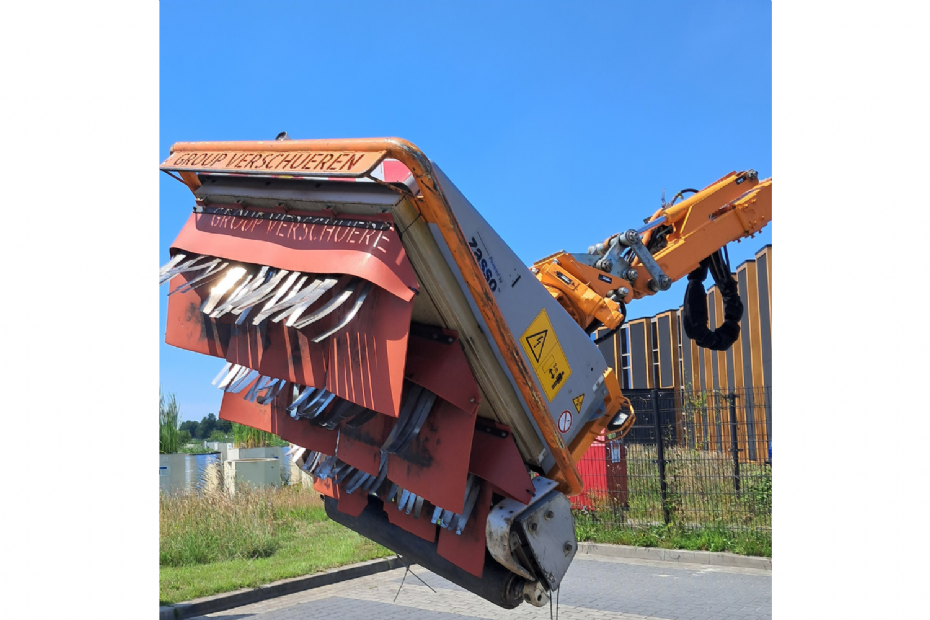 | | Unit mounted on a robotic arm, delivering multiple electric pulses (image via Tibach) |
|
|
Harry Kloosterman of Weed Free Service: "The Weed Lightning only targets plants that protrude above the rest. Others are unaffected. Controlling invasive species is site-specific; we choose whatever is safest and most effective per location." And Michel Wimmers of Wimmersson: "This method is emission-free and can be powered by solar energy."
Manual removal: suitable for small infestations
On small-scale sites, manual removal can be effective. Using hand tools or small machinery, rhizomes are removed. This works well for young infestations and sensitive environments where heavier equipment is undesirable. The downside: it is time-consuming and labour-intensive. Even a tiny remaining root fragment may cause regrowth.
 | | Covering with fabric (Image via KING Nonwoven Products) |
|
|
Covering with foil: simple in theory, precise in practice
A traditional method is covering the area with airtight foil. Without light and oxygen, the plant eventually dies. This works well on flat terrain without obstacles. In practice, the foil must fit tightly, remain in place for several years and be checked regularly. A single small tear can allow regrowth. A closed trench of about one metre deep must be dug around the patch, as rhizomes can spread underneath the foil. Dead plants should remain covered for a long time; removing them too early leads to regrowth. This makes the method demanding for the surrounding environment.
 | | Queeny de Haan |
|
|
Queeny de Haan of KING Nonwoven Products: "In the Weespersluispark development near Amsterdam, a special method was chosen. The contaminated soil was fully wrapped with Plantex Platinium, a strong but water- and air-permeable membrane. This blocks light, slowly depletes the rhizomes and prevents further growth. The method is effective where excavation or freezing is not feasible. Because the soil under the membrane remains healthy, the park can be designed and used as normal. It does require careful installation and regular maintenance: if the membrane is damaged or shifts, the plant may resprout."
Wrapping is mainly a long-term management measure, not a final eradication. Costs are relatively high and depend on surface area and soil conditions. Still, the method used in Weespersluis offers a practical balance between conservation, safety and control of a persistent invasive species.
Repeated mowing: cheap, but eradication is impossible
Mowing alone is not a solution. The plant regrows continuously and may spread through mown stems and root fragments. Repeated mowing can weaken the plant as part of a larger strategy. It avoids soil movement and allows selective use, for example along waterways. Effectiveness depends heavily on frequency and execution.
Keeping the plant low creates opportunities for other techniques to work more effectively. It is a cheap method but requires discipline over several years. Evers notes that the invasive species network of WUR tested the technique: "Mowing only spreads the plant and stimulates growth. It is a management technique; it cannot eradicate this invasive species."
Chemical control: effective, but limited
Glyphosate was used for many years as a last resort. It is effective because the active ingredient is injected directly into the stems. Regulations, however, are increasingly strict. Spraying is barely permitted and injection is limited. Environmental concerns also play a major role. Trials showed glyphosate still performs well, but its application scope has decreased. Another chemical option is Ultima.
Injecting every stem leads to a strong reduction in infestation but must be repeated over several years. Evers says spraying is pointless: "I've seen sites sprayed for 25 years with glyphosate. Only moss and Japanese knotweed remained. This method is hardly used anymore."
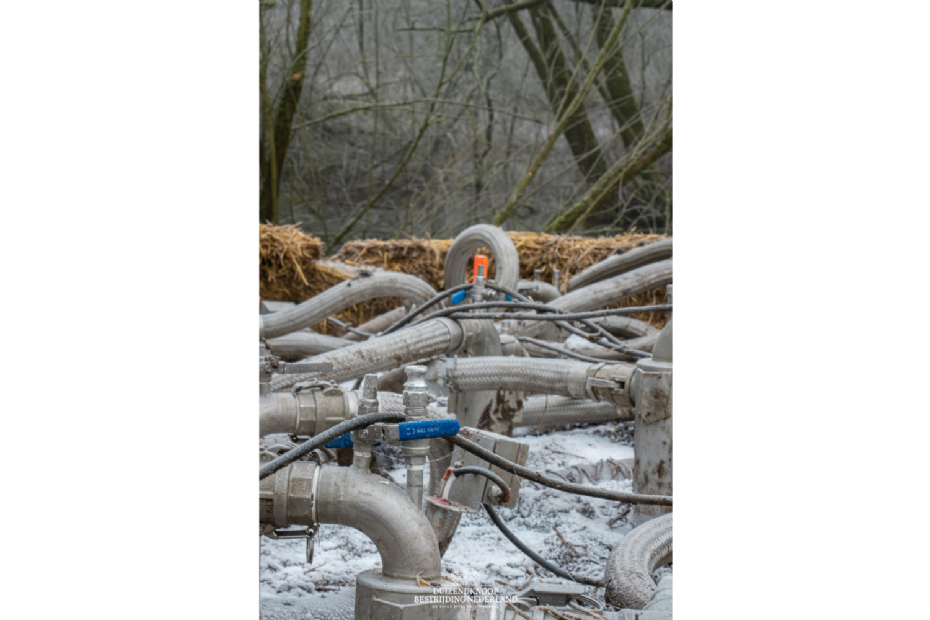 | | Freezing (Image via Biljoen Groen & Liemers Hendriks) |
|
|
Freezing: sustainable, but costly
Freezing the soil also proves effective. Freeze lances are placed in and around the infestation, and a biodegradable coolant circulates through a closed system. Within days, the soil freezes and the plant dies. Excavation is not required, preventing spread. Remains decompose on site and regrowth is limited. The method is sustainable, selective and environmentally friendly.
Biljoen Groen & Liemers Hendriks: "A major advantage is that one treatment is generally sufficient and the method does not harm soil life or the seed bank. Roots that have been at -5 degrees for at least 24 hours are no longer viable. The process can be monitored remotely and causes little disturbance."
There are disadvantages. The technique requires specialised equipment and expertise, and costs can be high. It is not suitable everywhere — large areas or sensitive sites may be problematic. Effectiveness depends on thorough execution; incomplete freezing can allow regrowth.
 | | The piping system used by JDK Solution for soil heating to remove Japanese knotweed (image via JDK Solution) |
|
|
Hot water: fast and suitable for large areas
Hot-water treatment is gaining traction. It offers a local, targeted and chemical-free approach. The Green Solution Hotwater supplies sustainably heated water at temperatures up to 99°C.
Bo Binkhorst of The Green Solution: "We use two hot-water methods. The first is injection. Hot water is injected directly into the ground and root zone, effectively cooking the plant. This works well in dry sandy soils, and about 2 m² can be treated per quarter hour."
In wet and dense soils such as clay, injection is less effective. The Green Solution therefore developed a second method using a vertical heat exchanger. Binkhorst: "Pipes circulate hot water through the soil, heating it to around 70°C — comparable to underfloor heating. This kills the roots as well. WUR is studying the method; interim results show roots completely dead after one treatment."
The advantage is that soil does not need to be moved, and treatment is quick: 100 m² can be completed within a week. "Hot-water treatment is often part of a combined approach. Small infestations are cheaper to remove manually, while larger areas can be handled efficiently with hot water."
 | | Coen Landheer of Oerwroeters (Photo: Aylin van den Houten) |
|
|
Grazing: nature-friendly, but limited in use
Biological control includes grazing by pigs or sheep. Pigs disturb and expose the root systems effectively; sheep are mainly suitable as a management tool, not for eradication. The method works locally but is unsuitable along dykes or roads.
"Our Tamworth pigs are used to reduce Japanese knotweed along the Amsterdam-Rhine Canal," says Coen Landheer of Oerwroeters. "They root through the soil, eat young shoots and weaken the plant over several years. Knotweed does not disappear completely, but it decreases significantly. It's a natural method that fits ecological management. The pigs also improve soil structure and fertilise the plot. It's a win-win: the land becomes healthier and the animals do useful work."
Mulching: minimal spread, simple logistics
GKB Machines recently introduced a machine that processes Japanese knotweed immediately after mowing. Jan-Willem Kraaijeveld: "Plant debris is shredded, pressed and ground into fine pulp on site, which is returned directly. Municipalities, contractors and site managers can treat infested locations quickly and safely without transporting material. This avoids spread and simplifies logistics."
Other experimental methods — UV radiation, liquid nitrogen, ozone, microwave technology and conductive heating — are still in the testing phase but may eventually contribute to broader control strategies.
No silver bullet
Successful control requires a combination of measures tailored to local conditions. Excavation is often combined with covering, or mowing with electrocution. Follow-up care is essential. Cleaning tools and machinery prevents spread, as does careful monitoring of treated locations. Those aiming to control the plant must choose an appropriate method — and stick with it. There is no quick fix, but several strategies fit different sites and goals.
This article was originally published on 1 December 2025 on the website](https://www.stad-en-groen.nl/article/51917/twaalf-bestrijdingsmethoden-tegen-japanse-duizendknoop]website) of Stad + Groen.
| Wageningen University and... | |
| Biljoen Groen & Liemers H... | |
| |
| LOG IN
with your email address to respond.
|
|
|
| There are no comments yet. |
|
| |
Anyone can place small ads for free through their own account.
Place a free ad
|
|
|
|