Good tree care starts in the soil |
|
|
|
|
 |
| 176 sec |
'Too often, trees are still planted with the hope that they will manage'
Planting a tree may seem simple: dig a hole, place the tree, add soil and you are done. In practice, according to many tree experts, this is exactly where things go wrong. The foundation for healthy trees lies in the soil. Yet the growing site often receives less attention than the tree itself. According to Ivo de Groot, owner of Moooz Green Solutions, this should change.
This article was previously published on March 23, 2026 on the website of Stad + Groen.
| With TerraFit, effective tree care starts in the soil |
'I often see trees simply being planted with the idea that everything will work out. But it does not work that way. A tree coming from a nursery has already undergone a major change. During lifting, a large part of the roots is often cut off. The tree is then transported and planted in a completely new location. That causes stress.' This is why proper preparation is important. 'If you look at the soil alone, you first need to understand what you are dealing with. What type of soil is present? What is the pH? What are the chemical properties of the soil?'
|
|
'Tree care literally starts in the soil'
| |
|
The right tree in the right place
According to De Groot, one of the first steps is choosing a tree species that matches the conditions. 'A tree that thrives in heavy clay soil will not perform well in sandy soil, and vice versa.' Next comes the growing site itself. In urban areas, the soil is often compacted due to construction activities, traffic or paving. 'You have to address that. Such soil is often hard and poor. Roots have little space and insufficient oxygen.'
One solution is to improve the soil by adding organic material and soil life. 'For example, you can mix fungus-dominated humus compost or root compost into the existing soil. This brings life back into the soil. It not only improves nutrition, but also the structure. It makes the soil more open and better able to retain water.'
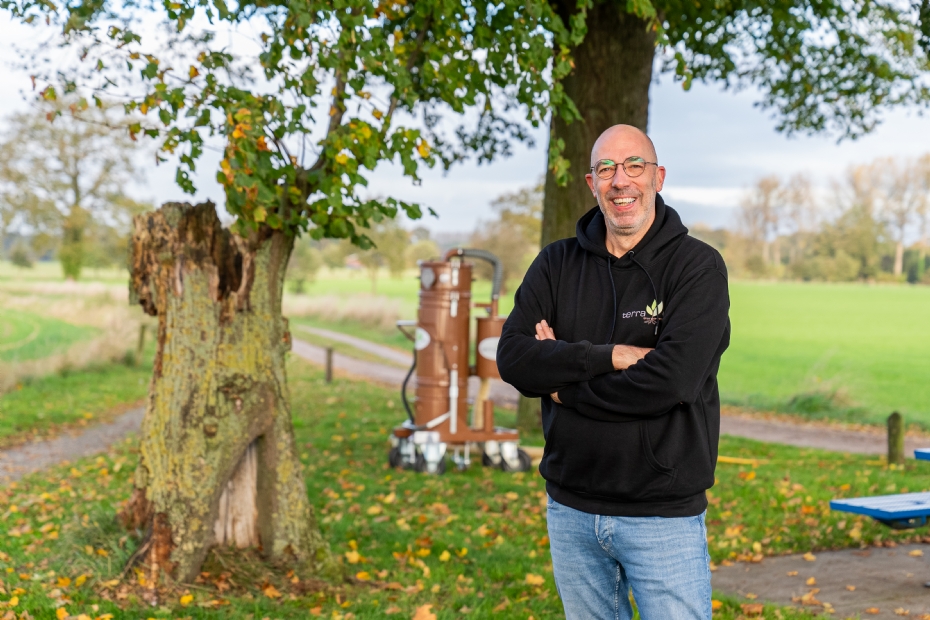 | | Ivo De Groot: 'Real tree care is not about pruning, but about a nutrient-rich and resilient soil' |
|
|
Aftercare is essential
Even if everything is well prepared, the work is not finished. 'It really starts after planting. The first years are crucial. During the first two years, you need to provide water, especially with the dry summers we experience nowadays.'
De Groot also advocates smarter management. 'Many municipalities water according to a schedule. But you should actually look at what the tree needs. With sensors, you can measure how much moisture remains in the soil.' According to him, there is a clear threshold: 'If moisture drops below twenty percent, the soil starts to dry out. Then a young tree will struggle.'
|
|
'If you think more carefully about the growing site from the start, you have already solved half the problem'
| |
|
Back to basics
Trees still sometimes struggle despite all care. In such cases, additional watering or maintenance is often applied. According to De Groot, it is better to return to the basics. 'You need to ask: why is the tree not thriving? What is the condition of the growing site? Sometimes that is where the problem needs to be solved.'
This is where soil improvement comes into play again. Techniques such as the TerraFit method can improve soil structure and add nutrients, even where paving is present. 'In many systems, compost is blown into the soil. That works well, but it often involves large volumes.'
His company uses a different approach. 'We use dry granulates with organic matter, fungi and bacteria. This achieves the same effect, but with less volume and weight.'
Compaction as a hidden issue
Soil compaction is a problem that is often underestimated. It is caused, for example, by construction traffic, paving or intensive use of the area. 'Compaction is something we often create ourselves. And afterwards, we need all kinds of measures to fix it.'
He sees this regularly in road reconstruction or new development projects. 'First everything is built, the soil becomes compacted, and then a small strip of green is added. A tree is planted there and expected to survive.' According to him, this is inefficient and short-sighted.
|
|
'It is far from sustainable to keep replacing trees because they fail to survive'
| |
|
Older trees also need care
Soil issues do not only affect newly planted trees. Older trees can also suffer. 'With mature trees, the natural cycle is often disrupted. Leaves are removed and taken away, which eventually depletes the soil. If possible, leave the leaves in place.'
A simple measure can already help. 'For example, apply a mulch layer under the tree. That allows nature to rebuild nutrients on its own.' This helps keep the soil healthy for longer. 'That tree may have grown for a hundred or even one hundred and fifty years under certain conditions. You should not suddenly change everything.'
A different way of looking
According to De Groot, progress has been made in the past twenty years. There is more attention for trees and their growing sites. Still, there is room for improvement. 'We need to look at trees differently. It is not just about planting a tree. Conditions matter. It starts with a simple idea: if you plant a tree, you want it to thrive. Trees can live much longer than often assumed. In Germany, there are trees that are hundreds of years old. That is also possible here. But sometimes we need to give them a bit of help.'
| MOOOZ Green Solutions B.V... | |
| |
| LOG IN
with your email address to respond.
|
|
|
| There are no comments yet. |
|
| |
Anyone can place small ads for free through their own account.
Place a free ad
|
|
|
|








