First private owners receive PEFC 'Trees Outside the Forest' certificate |
|
|
|
|
 |
| 172 sec |
'We are only stewards here'
Between Wierden and Hoge Hexel lies Pleisterplaats De Barkel, a rest point on the De Barkel estate in the Twente landscape where cultural history, nature and hospitality come together. Wim and Gerdien Boom have lived there for decades and manage the estate - and especially the grounds - with care for the trees, the landscape and the history of the place. 'We are stewards here,' says Wim Boom. 'You arrive with nothing and you leave with nothing. What matters is what you pass on.'
| Gerdien (centre) and Wim (right) of Pleisterplaats de Barkel receive the Trees Outside the Forest certificate from PEFC (Image: PEFC Netherlands) |
Their commitment to trees also became clear when part of the beech avenue in front of the house deteriorated. They decided not to carry out large-scale felling but to restore it. This required a major effort using a 30-metre aerial platform. 'We had the trees pruned back to living wood so they could regrow,' says Wim Boom. 'It was a risk, but it worked. The avenue now looks beautiful again.'
From avenue to oak grove
The grounds also include an oak grove, a cluster of nine oaks. 'Such a grove used to be very common,' Wim Boom explains. 'Farmers planted oaks to later use as beams for a new barn. Timber was worth its weight in gold.' The couple see it as their task to preserve that traditional knowledge and the landscape.
|
|
'Those who never visit nature do not know what there is to protect'
| |
|
Grounds with history
De Barkel has a long history. Traces from the Stone Age and Iron Age have been found on the site, and a burial mound has been reconstructed where such mounds once stood. The garden includes plants linked to different historical periods. Visitors can see which species were traditionally used for food or medicinal purposes. 'We want to show how people once lived with their surroundings,' says Wim Boom. 'That awareness also gives meaning to the present.'
The rest point has grown into a small-scale stop for walkers and cyclists. 'People come here for the peace and quiet,' says Gerdien Boom. 'Sometimes they say: we're here just to hear "nothing". That is the best compliment.'
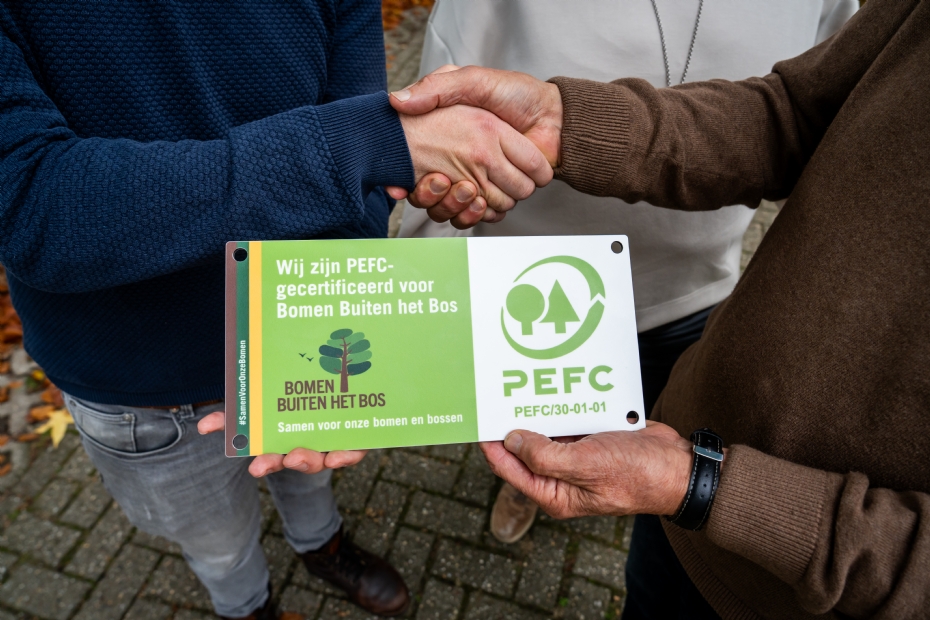 | | The Trees Outside the Forest certificate for Pleisterplaats De Barkel (Image: PEFC Netherlands) |
|
|
Pioneers twice
Wim and Gerdien Boom have worked sustainably with trees and the landscape all their lives. More than ten years ago, they were also the first private forest owners to receive a PEFC forest certificate. This PEFC label sets requirements for sustainable management, such as preserving native species, leaving deadwood, selective felling and replanting with indigenous trees. They have since renewed that certification. 'We like pioneering in that respect,' says Wim Boom.
Now they are again the first, this time with the PEFC 'Trees Outside the Forest' (BBB) certificate. PEFC Netherlands developed this certificate for trees and tree groups outside traditional forest areas. For these trees too, sustainable management is required. The revitalisation of the beech avenue is an example of this.
|
|
'The certificate is not a goal in itself but a confirmation. We simply want to show that this is possible'
| |
|
The certificate's principles align closely with the way Wim and Gerdien Boom already worked. 'We were already doing this, but with the certificate you demonstrate that your approach is verifiably sustainable and that you are committed to applying it in practice,' says Gerdien Boom. Certification also comes with responsibility. Periodic audits take place, and managers must demonstrate that they meet the criteria. 'It takes some time and money,' acknowledges Wim Boom, 'but it is a good way to stay sharp. You think more consciously about every intervention in the landscape.'
Awareness and example
Through certification, the couple also want to show that sustainable management is not only for governments or large estates. 'Alongside many public organisations, the Netherlands has countless homesteads and country places with valuable trees,' says Wim Boom. 'These too can be certified. You don't need a large forest to manage your trees responsibly.'
They see growing interest, especially now that more municipalities and organisations want to make their green management more sustainable. 'The municipality of Zwolle was the first authority to obtain the Trees Outside the Forest certificate,' says Wim Boom. 'But it is also feasible for private owners. It starts small - with awareness.'
They want to pass that awareness on to visitors and to the next generation. 'Children play in the garden here, learning about plants and insects,' says Gerdien Boom. 'Those who never visit nature do not know what there is to protect.'
The value of small steps
Wim and Gerdien Boom see their property as a small link in a larger whole. 'They are all postage stamps,' says Wim Boom, 'but together they make a difference.' His experience shows that sustainability does not begin with large projects, but with simple choices: keeping trees instead of felling them, planting native species, creating space for insects and birds. 'Sustainability is in our thinking,' says Gerdien Boom. 'The certificate is not a goal in itself but a confirmation. We simply want to show that this is possible.'
|
|
'Alongside many public organisations, the Netherlands has countless homesteads and country places with valuable trees that can also be certified. You don't need a large forest to manage your trees responsibly'
| |
|
This article was first published on 8 December 2025 on the website](https://www.stad-en-groen.nl/article/51916/eerste-particuliere-eigenaren-ontvangen-pefc-certificaat-bomen-buiten-het-bos]website) of Stad + Groen.
| LOG IN
with your email address to respond.
|
|
|
| There are no comments yet. |
|
| |
Anyone can place small ads for free through their own account.
Place a free ad
|
|
|
|





