When you make room for walking and cycling, you also create space for a climate-resilient city |
|
|
|
|
 |
| 135 sec |
"Without sustainable mobility, there can be no climate-resilient city"
The design of public space is under increasing pressure. We want to reduce heat stress, retain rainwater, strengthen biodiversity, and ensure liveability and safety. Awareness is growing that the puzzle is not just made up of green and blue, but also of grey. Maarten van Santvoort, marketing manager at Struyk Verwo Infra, sees sustainable mobility as the missing piece. "When you make room for walking and cycling, you also create space for a climate-resilient city."
| Wadi Hof van Holland in Nijmegen: a good example of a climate-adaptive and low-traffic street focused on liveability. The image shows lesser-known solutions from Struyk Verwo Infra, such as decorative stepping stones in the wadi and Solid kerbs. |
Van Santvoort advocates a broad view of sustainability. In his view, a climate-resilient public space depends on combining green, blue, and grey. "We need paving and hard surfaces to keep a city accessible and liveable. At the same time, we want to make as much space as possible for greenery and water. The key is not to see these worlds as opposites, but to bring them together."
He also points out that not everyone has the same priorities. "Some people want public spaces designed purely for sustainability, while others care most about staying dry or being able to walk safely. The grey elements will always be part of the picture. Without pavements or streets, you exclude groups of people — and that goes against the idea of an inclusive public space."
 | | Maarten van Santvoort |
|
|
|
|
"The key is not to see grey, green, and blue as opposites, but to bring them together."
| |
|
Mobility as a lever
Van Santvoort has become increasingly convinced of the role of mobility in this equation. He sees opportunities to use mobility as a lever for climate resilience. "Take Amsterdam. Effectively, 80 percent of its streets are now 30 km/h zones. In such zones, a separate cycle path is no longer needed — cyclists can ride on the carriageway. That saves a lot of space, which can then be used for infiltration, trees, or a rain garden."
According to him, this requires a cultural shift in the sector. "We still tend to think in fixed traffic patterns — car, cycle path, pavement. That's how we've always done it. But if we dare to let go of that mindset, space emerges — both physically and mentally."
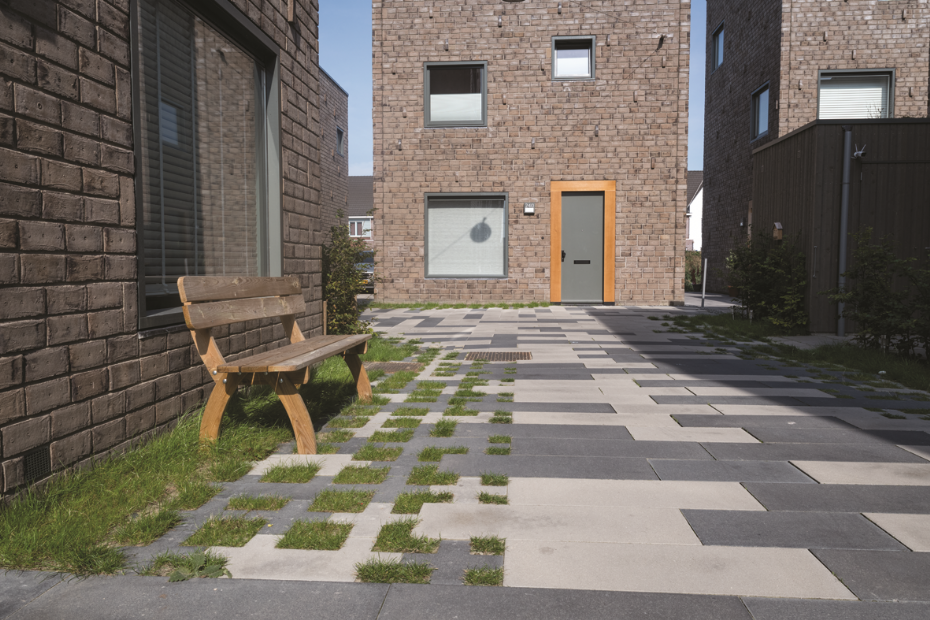 | | The Vrije Veld in Almere: a good example of a low-traffic street |
|
|
More goals, less space
Public space is expected to deliver more and more. Climate adaptation, biodiversity, social safety, and inclusivity are all competing for the same square metres, while budgets remain tight. That makes choices difficult. "Now more than ever, we need to work across disciplines," says Van Santvoort. "Fortunately, I see designers and contractors collaborating more often. In the past, everyone worked from their own silo, but there's growing awareness that this puzzle can only be solved together."
Such collaboration is also necessary to make trade-offs possible. "You can't achieve everything at once. A climate-resilient street must also be a liveable one. By connecting different disciplines, we can bring diverse goals closer together."
|
|
"I see opportunities to use mobility as a lever for climate resilience."
| |
|
Small pieces, big impact
Van Santvoort sees Struyk Verwo Infra's contribution as a collection of small pieces in the bigger picture. "We provide partial solutions that make construction with green, blue, and grey possible. These include permeable paving, grass paving, drainage kerbs and tiles, or custom-made concrete elements. Individually, they're small components, but together they make the system work."
Beyond design, the company also focuses on material sustainability. For example, CirCOton products partly use secondary raw materials, CERO products replace cement with geopolymer, and the Cycle for Concrete collection service ensures the full reuse of recovered concrete. "We're not only working on sustainable solutions for public spaces, but also on sustainable concrete for the future."
|
|
"A climate-resilient street must also be a liveable street."
| |
|
Rethinking as a starting point
For Van Santvoort, it all comes down to a different way of thinking. "Thinking differently creates space. If we keep holding on to old patterns, we'll get stuck. But if we dare to shift boundaries and conventions, much more becomes possible. Then there's room for sustainable mobility and for a climate-resilient public space."
 | | A drainage kerb (water-regulating kerb allowing outflow to greenery) in the Frans Halsbuurt |
|
|
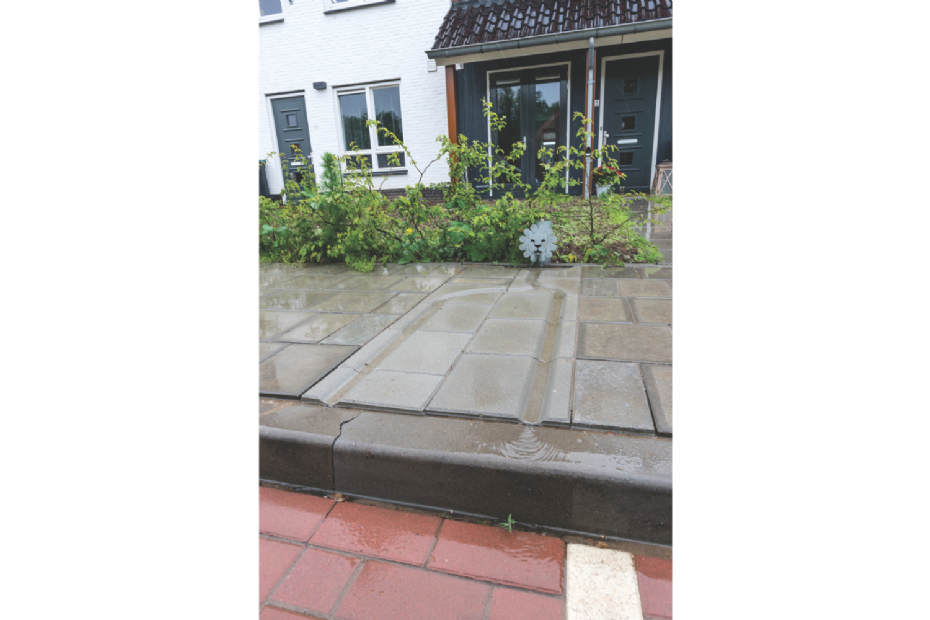 | | Climate-adaptive measures can also be fun: playful roof disconnection in Beneden-Leeuwen |
|
|
This article was originally published on 10 November 2025 on the website of Stad + Groen.
| LOG IN
with your email address to respond.
|
|
|
| There are no comments yet. |
|
| |
Anyone can place small ads for free through their own account.
Place a free ad
|
|
|
|








