Fifty years after the drought of 1976: what has public space learned? |
|
|
|
|
 |
| 178 sec |
Record summer shows how climate adaptation has shifted from future scenario to daily practice
The summer of 1976 is still etched in the memory of many people in the Netherlands. A 17-day heatwave, record drought and more than two million dead trees made it one of the most extreme weather years of the last century. Fifty years later, that summer is not only a meteorological benchmark, but also a mirror for how the Netherlands deals with climate adaptation, green space management and the design of public space.
This article was previously published on June 16, 2026 on the website of Stad + Groen.
| Image for illustration purposes, generated with AI |
In 1976, drought was mainly seen as an exceptional event. Today, municipalities, water authorities and site managers look at it differently. Drought and heat are increasingly regarded as structural challenges that must be addressed through design, management and policy.
|
|
The summer of 1976 is a mirror for how the Netherlands deals with climate adaptation, green space management and the design of public space
| |
|
From incident to recurring challenge
The drought of 1976 followed a long period with little rainfall and caused major damage to agriculture, nature and water quality. In some places, drinking water was rationed and the army helped with irrigation. The national precipitation deficit rose to 361 millimetres, a record that still stands.
Yet the perception of extremes has changed. While 1976 was long seen as an exception, several dry summers have followed in recent years. The period from 2018 to 2020 in particular made clear that prolonged drought is not a one-off event. The summers of 2022 and 2025 were also dry.
According to KNMI climate scenarios, Dutch summers will continue to warm and evaporation will increase faster than rainfall decreases. This increases the risk of water shortages, drying out of urban greenery and heat stress in cities.
Each degree of warming adds two tropical days
So far, the summer of 2026 has recorded three tropical days in De Bilt. On a tropical day, the temperature rises to 30 degrees Celsius or higher. That may not seem exceptional, but a hundred years ago such a day occurred on average only once per summer. Today, the average is more than four and a half tropical days per year. The warming of the Netherlands is therefore accompanied by a clear increase in hot days. Three steps show how quickly this development is progressing.
Step 1. List all measured summer temperatures;
Step 2. Count how often a certain temperature occurs over 30 years;
Step 3. Shift the 30-year periods forward one year at a time.
|
|
|
Drought and heat are increasingly regarded as structural challenges that must be addressed through design, management and policy
| |
|
A different view of urban greenery
The effects are visible in public space. Whereas trees used to be valued mainly for their appearance, they are now also seen as tools against heat, flooding and drought.
This has led to a different approach to green space design. Municipalities are investing more often in larger growing sites, open soils, infiltration facilities and tree species that are better able to withstand extreme conditions. More attention is also being paid to the relationship between water management, biodiversity and urban greenery.
The drought of 1976 showed how vulnerable trees and plants can be when water is absent for a long period. In current practice, the focus is therefore shifting from planting to long-term sustainable functioning.
|
|
The risk of water shortages, drying out of urban greenery and heat stress in cities is increasing
| |
|
From drainage to retention
Much has also changed in water management. For decades, the emphasis was on draining rainwater away quickly. Today, municipalities are trying to retain more water in the city.
Wadis, infiltration facilities, green roofs and water-retaining planting beds are increasingly part of new projects. At the same time, there is growing awareness that climate adaptation is not only about technical measures, but also about spatial choices. More paving means more heating and fewer opportunities to retain water.
What if 1976 happens again?
Climate models show that a summer like 1976 would be even more extreme in a warmer climate. Higher temperatures lead to more evaporation, drier soils and more water stress for trees and plants. A similar weather situation today would probably result in more tropical days, higher perceived temperatures and greater pressure on urban greenery.
This gives the summer of 1976 a new meaning. Not as a historic record once set, but as a warning of what could happen again.
|
|
Whereas trees used to be valued mainly for their appearance, they are now also seen as tools against heat, flooding and drought
| |
|
Looking ahead instead of looking back
For public space managers and designers, the challenge is therefore no longer to respond to exceptional weather conditions, but to design for extremes that occur more often.
The main lesson from fifty years of drought experience seems to be that climate adaptation is no longer a separate theme. It affects tree management, water management, biodiversity, urban development and residents' health at the same time. It is precisely this connection that determines how well cities and villages can withstand the next summer that enters the record books.
Heat impact
Heat impact is a new index in the KNMI app that shows how severe heat can feel. Heat impact combines four elements into one figure: temperature, humidity, wind and solar radiation.
|
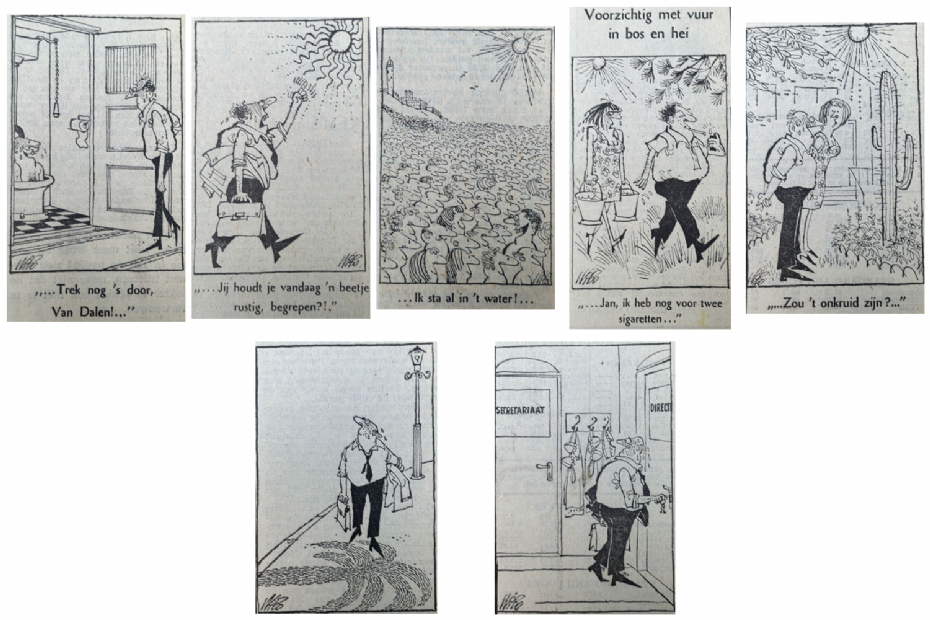 | | A compilation by cartoonist Wibo in de Volkskrant during the hot summer of 1976 |
|
|
|
|
For decades, the emphasis was on draining rainwater away quickly. Today, municipalities are trying to retain more water
| |
|
| LOG IN
with your email address to respond.
|
|
|
| There are no comments yet. |
|
| |
Anyone can place small ads for free through their own account.
Place a free ad
|
|
|
|