UV-C LED lighting: a practical technology for controlling diseases in sports turf |
|
| GARDEN AND PARK TECHNOLOGY |
|
|
|
|
 |
| 249 sec |
For field managers, the pressure to keep sports fields healthy is not getting any smaller. Chemical products are gradually disappearing from the toolbox, while performance requirements remain high. This raises the question of which technologies are genuinely practical in the field. According to Felix Oudshoorn, inventor of the UV-C Ledmaster, and Mark van der Ende of manufacturer Agroled, UV-C LED lighting offers opportunities. Not as a miracle cure, but as a technology that fits into an activity field managers already carry out: mowing.
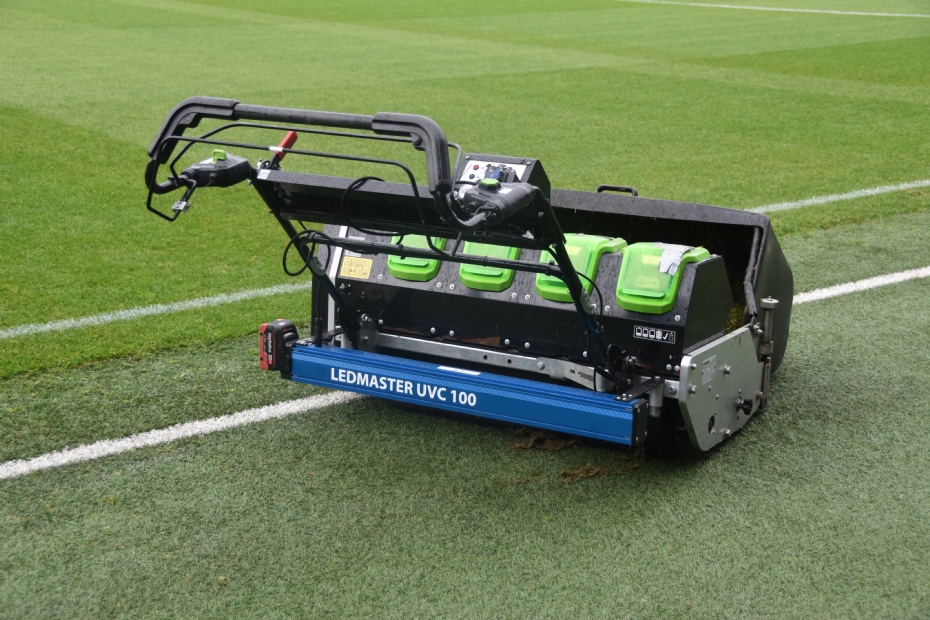 |
The objective is clear: reducing fungal pressure without requiring an additional operation. The technology primarily targets leaf diseases such as red thread and dollar spot and should be viewed as a system based on repetition and dosage, integrated into the overall management of the field. UV-C is a form of ultraviolet light with a short wavelength and therefore high energy. At a wavelength of around 265 nanometres, this light can damage micro-organisms. When fungi are exposed to it, their DNA is disrupted, preventing further development and reproduction. In practice, this means that pathogen activity can be significantly reduced, provided the dose is high enough. That dose depends on a combination of light intensity, distance and exposure time - in other words, the amount of energy reaching the surface. Oudshoorn explains it simply: 'You can think of it as a severe sunburn for micro-organisms. They do not recover from it.'
UV-C technology itself is not new. Systems using mercury-containing discharge lamps have been available for some time. The difference with the new generation lies in the use of LEDs. While traditional lamps emit a broad spectrum, the Ledmaster produces a single wavelength of 265 nanometres. This is known as monochromatic light. According to Van der Ende, this is an important factor in its effectiveness. 'We produce only at that one peak. With conventional lamps, only a small proportion of the light is truly effective.' In addition, discharge lamps emit light in all directions, whereas LEDs use a lens to direct it downwards. As a result, a much larger proportion of the energy actually reaches the turf surface. This means that the required exposure time remains short and micro-organisms can be affected within a fraction of a second.
|
|
'You don't need extra labour hours. You're already mowing.'
| |
|
The biggest difference lies not only in the technology itself, but also in its application. The Ledmaster was developed as a compact light bar mounted on a mower. This fundamentally changes its use: treatment takes place while mowing, without requiring a separate operation. Van der Ende explains: 'You don't need extra labour hours. You're already mowing.' For field managers, this is a key advantage because time and capacity are often the limiting factors in maintenance operations.
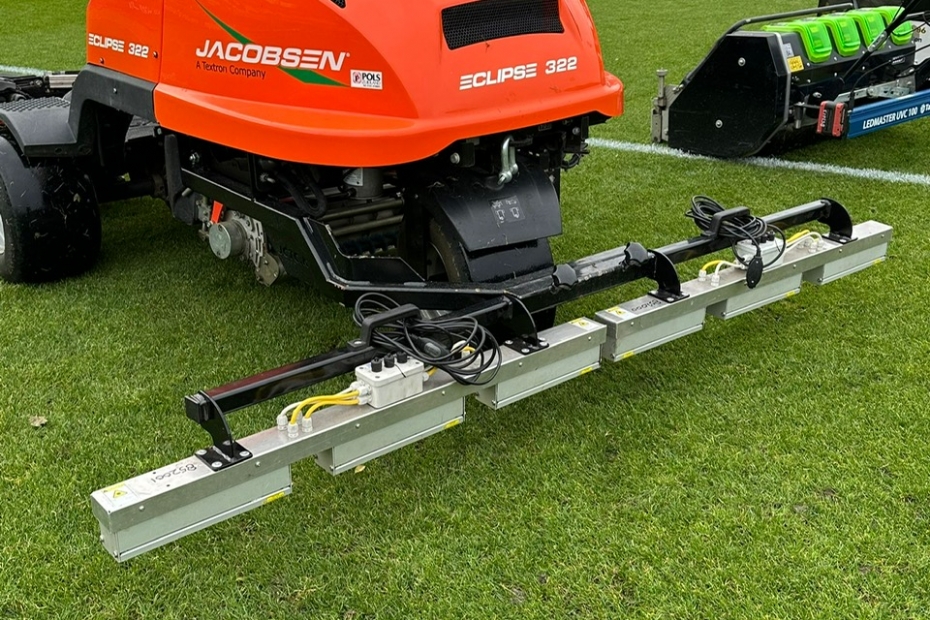 | | Two prototypes installed on the rear of a Jacobsen 322 ride-on mower and used at ADO in February 2023. |
|
|
Most vulnerable
The position of the light bar on the mower has been carefully chosen. When mounted behind the mower, the UV-C treatment follows immediately after mowing. This is precisely when the grass is most vulnerable. Mowing creates open wounds in the grass blades, providing entry points for pathogens. Oudshoorn highlights this moment: 'The sap flow is exposed. That's the main entry point for fungi.' Treating these wounds immediately significantly reduces that risk. It is precisely the combination of mowing and treatment in a single operation that makes the technology both practical and effective.
The effectiveness of UV-C depends on correct dosage. In practice, this means that operating speed, working height and treatment frequency determine the outcome. At a typical speed of around four to five kilometres per hour and a working height of approximately ten centimetres, enough energy reaches the turf to achieve an effect. If the mower travels faster or the distance to the turf increases, the amount of energy delivered per square metre decreases, reducing effectiveness. Existing infections can be addressed by increasing the dose through slower driving speeds or more frequent treatments. The system works cumulatively: each treatment contributes to further reducing fungal activity. The decisive factor is not the intensity of a single treatment, but the consistency with which treatments are carried out.
Since 2023, the technology has been used on fields including those of ADO Den Haag and Sparta. Mowing with the module attached takes place several times per week. In practice, the openness of the turf canopy plays an important role. This advantage is particularly noticeable following renovation work. In an open turf, light can more easily reach the soil surface, where it may also help suppress diseases such as Pythium. Mowing patterns are equally important. Working in different directions improves coverage and increases the amount of leaf tissue exposed to the light. According to those involved, visible results have been achieved against diseases such as red thread and Fusarium by temporarily increasing treatment frequency.
An important practical question is how UV-C affects young grass or overseeded areas. Based on field experience - although no international scientific literature currently provides definitive conclusions - grass seed germination appears to remain unaffected. Young grass may show a slight reaction, but this generally recovers quickly. As a result, the technology can also be used in situations involving overseeding or renovation.
|
|
The technology should therefore be regarded as part of a broader maintenance system.
| |
|
UV-C only works where the light actually reaches. This makes the technology particularly suitable for closely mown sports turf, such as football pitches and golf greens. In longer grass or rougher areas, effectiveness decreases because the light penetrates less effectively to the leaf surface and soil. Problems deeper in the rootzone are not directly addressed, although keeping fungal pressure low on the leaf surface can help limit further disease development. The technology should therefore be viewed as part of a broader maintenance system, in which factors such as nutrition, water management and soil aeration remain equally important. A practical advantage is that UV-C leaves no residue. Unlike chemical applications, there are no re-entry restrictions and no risk of leaching into the environment. Weather conditions also play a much smaller role. In principle, treatments can be carried out under a wide range of conditions, making planning easier.
Keep moving
The light bars are robustly built and suitable for use under a wide range of conditions. They are waterproof and require little maintenance, with lens cleaning generally being sufficient. Power is supplied by a replaceable battery with an operating time of several hours, enough for a standard mowing session. Operation is relatively straightforward, but some care is required. The most important point is that the machine must not remain stationary while the system is switched on, as this could create an excessively high local dose. Under normal mowing conditions, where the machine is continuously moving, this does not pose a problem. The investment is approximately €8,200 per unit. In practice, two units are often required per field, depending on the working method. This is offset by low operating costs and potential savings on chemical products and additional treatments.
Logical addition
UV-C LED lighting is not a quick fix that solves every problem at once. It requires a different approach, with consistency and integration into routine maintenance at its core. Precisely because the system operates during mowing, it is practical to implement and fits naturally into the daily work of field managers. For turf managers who need to work without chemical products, it offers a practical and logical addition to their maintenance strategy. As Van der Ende summarises: 'Attach it, and you simply forget it's there.'
This article was previously published on 12 June 2026 on the Fieldmanager](https://www.fieldmanager.nl/article/54400/uv-c-ledverlichting-praktische-techniek-tegen-ziektes-in-sportgras]Fieldmanager) website.
| LOG IN
with your email address to respond.
|
|
|
| There are no comments yet. |
|
| |
Anyone can place small ads for free through their own account.
Place a free ad
|
|
|
|








